
What to see at Patriarch's Ponds
The history of Patriarch's Ponds
History of origin: from Goat marshes to Patriarch ponds
There are many legends and mystical stories associated with the Patriarch's Ponds. There is a belief that there was a swamp in their place, and its depths kept many terrible secrets. Even before the formation of Moscow, these surroundings were favored by pagan priests, whose rituals ended with sacrifice – drowning in a quagmire. There was a rumor that on special occasions, the victims were previously mercilessly beheaded. In the Middle Ages, people called these marshes Goat marshes. No one knows for sure why this particular name was chosen, but there are two assumptions. The first is that there was a Goat yard next to the marshes, which supplied goat wool to the court of the tsar and other high-ranking officials. Hence the name of the area. The second version completely refutes the involvement of any animals in this. It is based on the dark past of those places. Evil spirits lived in the swamps and plotted. Perhaps it was the restless souls of the drowned who did not find peace.
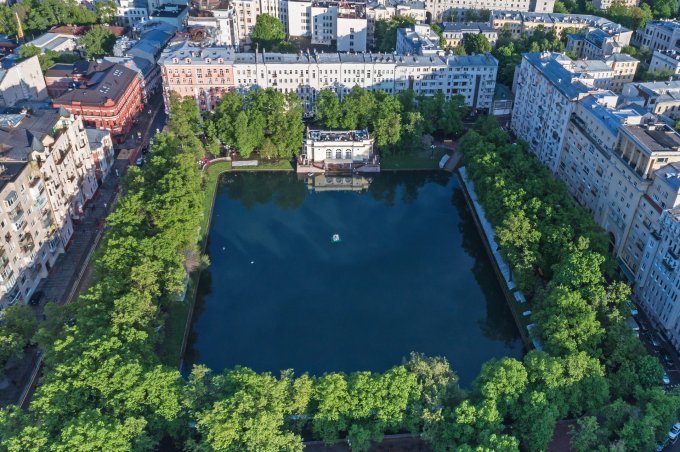
At the beginning of the 17th century, this territory was transferred to the residence of Patriarch Hermogenes, who formed a Patriarchal settlement with two churches – Ermolai the Holy Martyr and Spyridon of Trimifunt. In 1680, under the leadership of the new owner of the settlement, Patriarch Joachim, a former military man, the marshes were drained, and instead three ponds with clean water were formed, named Patriarchs in honor of the priest. The next patriarch on the ponds, Adrian, was the last of his kind in pre–revolutionary Russia. Later, under Peter I, the patriarchate was abolished. After Adrian's death, the ponds were no longer looked after. Without proper care, they took care of themselves again, and the settlement itself fell into disrepair. After the fire and devastation of the Patriotic War of 1812, the Patriarch's Ponds, like other areas of Moscow, were put in order. It was decided to leave only one reservoir. It was cleaned, fish were launched, trees and shrubs were planted around it. The other two fell asleep. But the name remained the same, in memory of the fact that it was given in honor of the three ponds. In 1924, the authorities of the USSR, which do not recognize religion, changed the name of the area to "Pioneer Ponds", but it did not take root, people still continued to call them Patriarchal. 68 years later, in 1992, the former name was returned to the official level.
The 30s of the XX century were marked by the appearance of a gang of people with hypnotic abilities on the Patriarchs. Presumably, this fact formed the basis for the beginning of Mikhail Bulgakov's work "The Master and Margarita". Woland came here for a reason as soon as he arrived in Moscow. And poor Berlioz, very close to this place, so unsuccessfully slipped on spilled oil. Apparently, after hundreds of years, the evil spirits have not left their favorite place and continue to plot against everyone. The Patriarchal Gardens have become a landmark place for fans of Bulgakov's works.
In 1974, a monument to the famous fabulist I.A. Krylov was erected in the park. He is surrounded by twelve heroes of his works. Among them are members of the quartet Monkey, Donkey, Goat, Bear, representatives of other fables — Monkey with glasses, Elephant and Pug. Crow and Fox and others. The author of the sculptural composition is A.A. Drevin.
Bulgakov's Patriarchal Ponds: to be or not to be
Today, Muscovites affectionately call the Patriarch's Ponds Patriki. Young couples and older people like to walk here. Everyone is attracted by something different: a beautiful green park, clean water with the opportunity to feed the ducks and swans living here, the desire to touch something mysterious and mysterious, to become an invisible witness to the exciting events that fill the very atmosphere of the Patriarch Ponds.
In 1999, it was planned to install a sculpture ensemble dedicated to the work of Mikhail Bulgakov in Patrikov Square. Together with the author sitting on the shore of the pond, it was supposed to build sculptures of characters from his famous novel. Yeshua Ha-Nozri was supposed to walk on the water towards Bulgakov, and the Master and Margarita, Behemoth, Azazello, Pontius Pilate, Koroviev and others were located around the reservoir itself. But the project faced financial problems and numerous protests from local residents. To date, it has not been translated into reality.
In 2003, a large-scale reconstruction of the Patriarch's Ponds and the surrounding park was carried out. Fish were launched into the pond, new trees were planted in the park, the paths were paved with paving stones and paved with paving slabs. New benches and city lighting masts were installed. The park was recognized as a cultural heritage site and came under state protection.
In 2004, the territory of the Patriarch's Ponds Park was included in the list of regional heritage sites.
Patriki is never empty. In winter, people skate here, in summer they have picnics with snacks near the reservoir, in spring and autumn they stroll through the beautiful park, enjoying nature. There are numerous cafes and restaurants nearby where you can sit and relax with tea or a soft drink, or you can take delicious cakes with you to eat them by the pond.
Famous residents
Creative people often settled here. At the beginning of the 19th century, the famous poet and fabulist Ivan Dmitriev lived on Patriarch's Ponds (17 Spiridonovka Street), who regularly hosted literary evenings. The guests were E. A. Baratynsky, V. A. Zhukovsky, K. N. Batyushkov, A. S. Pushkin, A. A. Delvig, P. A. Vyazemsky, N. V. Gogol. In short, the area was a place of attraction for Moscow's literary bohemians at that time.
Dmitriev's house has not survived to this day: in its place now stands the mansion of Zinaida Morozova, the wife of the famous Moscow philanthropist Savva Morozov. The building was built by architect Fyodor Shekhtel, the brightest representative of Moscow Art Nouveau. It now houses the Reception House of the Russian Foreign Ministry.
Thirteen—year-old Vladimir Mayakovsky lived in 12 Spiridonyevsky Lane for a year - it was his first Moscow apartment.
There was once a wooden one-story, brown—painted house at 8 Trekhprudny Lane, where the poet Marina Tsvetaeva was born in 1892. Here she grew up and matured, until in 1914 the building was transferred to the hospital, and Marina Ivanovna moved to another address in Borisoglebsky Lane. In 1919, the house in Trekhprudny was dismantled, and now the building of the Creativity cooperative stands in its place.
Alexander Blok spent his only Moscow winter at the Patriarchs — he and his young wife Lyubov Mendeleeva settled at 6 Spiridonovka Street.
Avant-garde artists Mikhail Larionov and Natalia Goncharova lived and worked here. This place has become a landmark in the history of the Russian avant—garde - S. P. Diaghilev, A. V. Lentulov, I. I. Mashkov, P. P. Konchalovsky came here. The workshops were located in the Goncharov family home at 2a Trekhprudny Lane, which was built according to his own design by the artist's father, architect Sergei Goncharov.
There is another creation by Fyodor Shekhtel at the Patriarchal Gardens. In 1896, the architect built his own mansion at Ermolaevsky Lane, 28. This building is in a pseudo-Romanesque style. Since the 1950s, the Embassy of Uruguay has been located in the house, but you can get inside during the days of historical and cultural heritage (April 18 and May 18).
The genius of the place
Fyodor Shekhtel is the most famous architect of this area. Next to the Patriarch's Ponds, he built two of his own houses: the first — in the Art Nouveau style ("a hut of obscene architecture," in his own words), in Ermolaevsky Lane, and the second — a neoclassical mansion on the Garden Ring.
What's interesting at Patriarch's Ponds
Every winter, an ice rink with a total area of 12,000 m2 is organized on the ponds, and sometimes a Christmas tree is put up. This tradition has existed since 1900, when Leo Tolstoy himself came here with his daughters to skate with them.
The territory of the Patriarch's Ponds is used as a venue for mass celebrations: Carnival, various festivals, city day.
"Bulgakov evenings" are held here, second-hand book fairs are organized.
Since 2013, the Patriarchs have been gathering participants of the charity run "Patriots Run" every year. The funds received are transferred to the Galchonok Foundation, which provides assistance to children and youth with organic lesions of the central nervous system.
The Museum-theater in the "bad apartment"
Not far from Patrikov, at 10/50 B. Sadovaya St., in the very "bad apartment" mentioned in Mikhail Bulgakov's novel "The Master and Margarita", the Bulgakov House Museum-theater is open. The author of the work himself lived here in the period from 1921 to 1924. In the museum you can see old photos, documents, medical instruments of the writer, an electronic composition with all photographs, written materials and films based on Bulgakov. The museum offers guided tours of the night capital with visits to mystical places associated with Bulgakov. In addition, there are theatrical performances, musical concerts, exhibitions and other important events. The museum has an official website with all the necessary information about its work.
What to see at Patriarch's Ponds?
Here you can not only walk in the park by the water, but also visit interesting cultural places nearby.
Mikhail Bulgakov Museum
Address: 10 Bolshaya Sadovaya Street
Mikhail Afanasievich lived in one of the ten rooms of the communal apartment with his first wife Tatiana Nikolaevna Lappa for three years in the early 1920s. This place has gone down in history as a "bad apartment." She really was ill-fated: restless neighbors constantly quarreled, shouted and caused the couple a lot of inconvenience. And Bulgakov copied the very Annushka who spilled the butter from his quarrelsome neighbor, without even changing her name. The museum recreates the atmosphere of the writer's first home in Moscow, and also conducts a variety of thematic excursions, walking tours, lectures and interactive activities for adults and children.
Bad neighbors
The literary characters Koroviev and Behemoth from the novel "The Master and Margarita" are not fictional. These are Bulgakov's neighbors at 302 BIS Bolshaya Sadovaya, who live in apartment 13 Binder and Orleansky. In 1925-1935, they were part of a famous gang of hypnotists.
Museum apartment of A.M. Gorky
Address: 6/2 Malaya Nikitskaya Street, building 5
One of the most famous projects of Fyodor Shekhtel in Moscow. The famous Ryabushinsky Mansion, built for a wealthy Moscow businessman and Old Believer in the early 1900s, houses the Gorky Memorial Museum. The writer spent the last five years of his life here. According to the interiors, which have been preserved in a greatly modified form, even today one can appreciate the taste and scope of the first owner of the house. The most famous object inside is the grand staircase, a wave with a lamp in the form of a jellyfish. It can take a very long time to study the details indoors. By the way, the Ryabushinskys' religious beliefs are evidenced by the house church on the top floor of the building.
A. N. Tolstoy's Museum apartment
Address: Spiridonovka street, 2, p. 1
It is located in the wing of the Ryabushinsky mansion. A small four-room exhibition tells about the writer's life from 1941 to 1945.
Moscow Museum of Modern Art (MMOMA)
Address: Ermolaevsky lane, 17
It is located near the Alley of architect Fyodor Shekhtel and his mansion in Ermolaevsky Lane. One of the MMOMA exhibition grounds is open here. Temporary exhibitions are located on several floors of the museum, most of which are free of charge. There is also a library with art books. You can come here and just work — the hall has a convenient seating layout and is almost always sparsely populated. There is a small cafe on the ground floor of the building.
Ice rink
Every year, citizens and guests of the capital enjoy a large skating rink on Patriarch's Pond: the tradition of skating on the frozen pond in winter has been going on since 1900. Nowadays, the rink is illuminated by 16 floodlights, and skate rentals are available. As in the old days, you can ride on the Patriarch's Pond for free.
Skate rental — 200 rubles.
Malaya Bronnaya Street and Lubavitcher Synagogue
To explore the area in more detail, walk along Malaya Bronnaya Street past the Patriarch's Ponds. Like the name of the neighboring Bolshaya Bronnaya, the name of this street comes from the armourers' quarter, which existed here in the Middle Ages. A place frequented by Moscow's literary and artistic intelligentsia since the middle of the 19th century, today it is the Moscow equivalent of Hampstead in London or Greenwich Village in New York.
Malaya Bronnaya Street
Among a large number of antique shops and trendy restaurants stands a monument to Sholom Aleichem, a popular Jewish writer (1859-1916), whose stories became the basis for the play "Fiddler on the Roof" (the characters of which are depicted on the pedestal of the monument). Although he never lived in Moscow, translations of his plays are still performed on the Moscow stage, and this place is quite suitable for a monument – there used to be a State Jewish Theater here.
Another reminder of Russia's Jewish traditions is located near the confluence of Bolshaya Bronnaya and Malaya Bronnaya: a pale green and white neoclassical building in the shadow of a huge concrete monster. Agudas Chassidei Chabad, or Lubavitcher Synagogue, was built as an Orthodox synagogue in 1863 (after the liberation of the Jews by Alexander II), funded by the railroad magnate Polyakov.
In the early 1920s, the building was handed over to Hasidim, whom the Communists initially sympathized with more than "bourgeois" Orthodox Jews, but this uneasy coexistence came to an end after World War II, along with the purges of "cosmopolitans" and the closure of the synagogue. When Yeltsin returned this building to the Hasidim in 1991, he visionarily allowed the remnants of the flock of Rabbi Schoenberg, the founder of the Lubavitcher community, who was arrested by the KGB in the 1960s, to attend prayer services there, thus gaining the favor of wealthy emigrants belonging to the Lubavitcher community.
Theater on Malaya Bronnaya
The strict interior of the synagogue is distinguished only by the modest tabernacle located under the altar, but the community spared no expense on the huge cultural center located next door. Located further down the street, the theater on Malaya Bronnaya occupies the building that once housed the State Jewish Theater, whose outstanding actor and director Solomon Mikhoels was secretly shot by the NKVD, and the theater itself was disbanded.
Restaurants and cafes on Patriarch's Ponds
Near the Patriarch's Ponds, within walking distance, you can easily find a cafe, restaurant, bar or other catering establishment to suit your taste. There are countless of them here: bars with a wide range of wines, cozy cafes with homemade cuisine and sweet pastries, small chamber pubs, expensive fashionable restaurants. Everyone will find exactly what they are looking for.
If a visit to a restaurant is planned in advance, it is better to book a table in advance. Patriarch's Ponds are popular, and on certain days it can be crowded and you may not find a free place.
The selection of restaurants presented below includes eight of the most popular establishments that have proven themselves in the eyes of visitors with the cozy atmosphere of the room, delicious cuisine and excellent serving of dishes.
Salumeria
When you get here, you get to Rome. All the pleasures of Italy are available here: national cuisine, traditional Italian aperitif, the best authentic Italian coffee in the world. Special attention should be paid to the bar. You can hardly choose one of the drinks. It could be a Torrent, a legendary Vintage, something from a collectible wine list.
The address of the institution is Spiridonyevsky Lane, 12/9.
Nude Sofa & Wine Vag
A small but cozy family coffee shop with a wine bar, set up in a 1930s apartment building on the ponds. Rich and delicious American pancake pancakes are served here for breakfast, and in the evening you are invited to stop by for a glass of wine.
The address of the institution is 24/1 Spiridonovka Street.
Cutfish
Sushi bistro with an open kitchen. They offer a pan-Asian menu. The order is prepared in the presence of the client. The portions are small but delicious. The intrigue is that it is not customary to cut the rolls into pieces here, it will be whole and appetizing. The wine list is rich in an assortment of sweet, semi-sweet and dry wines made from different grape varieties.
The address of the institution is 17 Bolshoy Kozikhinsky Lane.1.
Remy Kitshen Wakegu
The project combines 2 halls of the restaurant and a separate hall for cooking – bakery. Bread and croissants are baked here. You can try them directly at the restaurant, or you can take them with you to take away. The menu features traditional dishes of mixed cuisine. The portions are large enough, the staff is polite, and the interior is pleasant. The restaurant is located on the corner of the building and has many floor-to-ceiling windows, which gives a lot of light. In the warmer months, the tables are brought out onto the veranda.
The address of the institution: Malaya Bronnaya street, 2, p.1.
Uilliam's
The signature restaurant of chef Lamberti, who simply loves to personally communicate with his guests. It offers dishes of European, Italian, author's, and mixed cuisine. No sandwiches or quick snacks, only delicious and satisfying food, such as grilled duck or quail. The menu is written in English. There is a private bakery and a wine list. Meals can be taken away.
The address of the institution: Malaya Bronnaya street, 20A
More
A pastry shop located a few steps from the Patriarch's Pond. The establishment is often referred to as the window to Paris. Branded hot chocolate is served here, and classic French desserts, cupcakes, and famous macaroni cakes are alluring to taste. French toast, jam and sweets are served with tea and coffee. Natalia Chistyakova Ionova and Victoria Daineko became regulars of the pastry shop, which you can accidentally encounter there.
The address of the institution is: Malaya Bronnaya street, 27/14.
Boxonito
The restaurant is famous for its amazing thin and delicious pizza, cooked in a wood-burning oven according to the author's recipe. There are a total of 20 types to choose from. It serves homemade pasta with numerous original sauces, shrimp and delicious coffee. Lovers of stronger drinks are offered Italian wines: red, white or light sparkling. The restaurant has a relaxed atmosphere.
The address of the institution is 4 Bolshoy Patriarchal Lane.
Foca Gallery
The restaurant specializes in Italian cuisine. The signature dish is focaccia. They also offer lasagna, croissants, and pizza. It is possible to order gluten-free pizza.
The address of the institution: Malaya Bronnaya street, 26, p.1.
Where to stay
To get a better look at the Patriarch's Ponds, stay at a hotel within the 3rd ring. A good option is the Maxim Panorama hotel closest to the Patriarch's Ponds. MAXIMA HOTELS will be an ideal stopping point to see the best sights of Moscow.
How to get
By metro — go to the stations "Mayakovskaya" (less than a kilometer to the park), "Pushkinskaya" (about a kilometer away), "Barrikadnaya" (walk a little more than a kilometer).
By bus, there is a ground transportation stop "Malaya Bronnaya — Most Theater". You can get there by buses B, T10, T39 and 869 (the last two routes depart from the Mayakovskaya metro station, conveniently with a transfer).
By car — the car can be parked in paid and free parking lots on nearby streets of varying degrees of distance from the park.
- Address: 7 Bolshoy Patriarchal Lane, building 1, Moscow
- Work schedule: 24/7
- Cost: entrance to the park is free
The authorship of the photo is published unchanged: A.Savin. Own work, FAL