
What to see in Moscow in 3 days
Many people visit Moscow on the way, waiting for the time before the plane, especially those who, like us, live in the provinces. We stopped here several times to transfer to Thailand, because tickets were cheaper that way. It is also an opportunity to visit the heart of our Motherland.
What to see in Moscow in 3 days on your own or a must see in Moscow if you come here for a short time or even if you are a Muscovite and "still have time" will be this article. My daughter and I managed to visit two or three places of interest a day, and the walks took place without running or haste.
Let's go for a walk along Zlatoglavaya Street together with us — "There is a Russian spirit here, it smells of Russia here..."
Day 1: Red Square and surroundings
- On foot. The entire route to Red Square and the surrounding area can be done on foot, it is not necessary to take the subway, the main thing is that your home is located in the city center.
- Recommended days. Any day of the week is good to visit, except Thursday, as the Kremlin closes on that day. Keep in mind that the rest of the museums in the city are closed on Mondays.
9:00 Walk through the Red Square.
The 3-day Moscow route starts from Red Square to explore the city center. Located in the city center, it has a length of 330 meters and a width of 70 meters (23,100 square meters). In 1990, the entire Red Square and the Kremlin were declared a UNESCO World Heritage Site.
The buildings that can be visited on this square arevery diverse, and each of them has a special significance: the Kremlin (the official place of work of the president and where the main museum of Russia is located), the Lenin Mausoleum (where the mummified remains of the Bolshevik leader are located), the cathedrals of St. Basil the Blessed and Kazan, the State Museum of the History of Russia or the GUM Galleries (luxurious commercial galleries).
A 15-30 minute walk around Red Square and its surroundings (Revolution Square, Alexander Garden and Grave of the Unknown Soldier) will allow you to sit down and admire the beauty of the city center. Since I assume that you purchased a ticket online to visit the Kremlin, it is advisable to go and redeem the voucher for the final tickets at about 9:30 or earlier.
10:00 Moscow Kremlin (I): Armory Chamber and Diamond Fund.
The first visit I recommend is to the Kremlin Armory. To visit the Armory, it is strongly recommended to purchase a ticket online. You can buy tickets for one of the 4 passes: for 10:00, 12:00, 14:30 or 16:30 (the visit is free, without a guide). In this route, I assume that you bought for the 10:00 session.
Inside the Armory, you can buy a ticket to visit the famous Diamond Fund.
- The duration of the visitis about 2 hours.
- Price: 1000 rubles. It is advisable to buy tickets online.
- Opening hours: open from 10:00 to 18:00.
There are no restaurants inside the Kremlin, so I recommend visiting the Armory in the morning and returning to the Kremlin after eating outside to visit Cathedral Square, as it is another area in the Kremlin's interior with a different entrance that can also be purchased online.
An alternative. Another alternative is to visit the Armory and Cathedral Square in a row, but keep in mind that it will take about 4 hours, and it may be a bit difficult, especially since there are no restaurants inside. In this case, you can take some snacks with you to have a snack on the way and finish both visits at 2 p.m. to get outside the Kremlin and eat.
12:00 St. Basil's Cathedral.
At the exit of the Armory, you will be able to appreciate the Alexander Garden, in the main entrance of which there is the grave of the Unknown Soldier, a monument dedicated to Soviet soldiers who fell in the Great Patriotic War, in the center of which the Eternal Flame burns, guarded by the honor guard of the Presidential Regiment.
The changing of the guard takes place every hour, and tourists like to go there to watch. After leaving the Alexander Garden and crossing the Red Square, you can go to St. Basil's Cathedral, the symbol of the city, despite the fact that it is not the main cathedral of Moscow, as this place corresponds to the Cathedral of Christ the Savior. Read about other churches in Moscow in the article at the link.
- Duration of the visit: thevisit can be completed in about 1 hour.
- Price:700 rubles (1200 rubles with audio guide). Tickets can also be purchased online. There are usually no long queues, and if there is one, it moves quickly.
- Schedule: in summer, from June 1 to August 31, it is open from 10:00 to 19:00 (from 11:00 to 18:00, the rest of the year).
After visiting St. Basil's Cathedral, you can also visit the Cathedral of the Kazan Mother of God, which is located in the northeast corner of Red Square in Moscow and which is free of charge. You can visit it in 15 minutes.
14:00 GUM Galleries
After visiting the cathedrals, it's time to visit the GUM shopping galleries, Russia's most famous shopping center and the most visited by tourists in Moscow. There are several self-service restaurants on the third floor where you can eat very sparingly and quickly on the terraces while admiring this impressive shopping mall.
- Duration of the visit: 1-2 hours to eat and see the galleries.
- Price: entrance to the mall is free.
- Opening hours: GUM Galleries are open every day from 10:00 a.m. to 10:00 p.m.
Another place where you can eat near Red Square and where there are many different restaurants is the Okhotny Ryad Shopping Center, a multi—level underground shopping center located under the Alexander Garden and next to the Kremlin.
16:00 Moscow Kremlin (II): Cathedral Square
After lunch, the visit can be continued in the Kremlin, namely on Cathedral Square.
- Duration of the visit: it may take about 2 hours.
- Price: 700 rubles. It is advisable to buy tickets online.
- Opening hours: in summer, the section of the Kremlin Cathedral Square is open from 9:30 to 18:00.
At this point, you can return to your hotel, relax a bit and continue your visits in the afternoon. Or, if you prefer, continue your visit towards the Bolshoi Theatre.
18:00 p.m. Bolshoi Theater and Tverskaya Street
From St. Basil's Cathedral, it's worth walking from Red Square to Revolution Square, bypassing Theater Square, to the Bolshoi Theater to admire the beauty of this famous building. Next to the Bolshoi Theater, if you want to shop, there are large TSUM department stores in a historic six-story building in the Neo-Gothic style.
From here, if you still have the stamina, you can head to Tverskaya Street, Moscow's most famous street, full of advertisements, luxury shops, and restaurants. At No. 14 on this street is the Eliseevsky grocery Store, opened in 1901, which has several luxurious interiors. You can end the tour with a restaurant lunch: you can choose between an economical one, like in the Mu-Mu restaurant chain, or go to the Pushkin Cafe, probably the most famous restaurant in Moscow (book in advance, this can be done on their website). You can also find many other restaurants with a wide variety of cuisines in the area.
The second day
The second day can be devoted to a walk around the city. Visit iconic places. Take a look at the Patriarch's Ponds, inextricably linked with Bulgakov's novel "The Master and Margarita", visit the zoo, the planetarium, admire the most beautiful bridges… Maybe we won't be able to make everything we've planned a reality – for example, you can only spend a whole day at the zoo. Still, it's worth trying to include as many objects as possible in your program.
Patriarch's Ponds
As the name suggests, there used to be several ponds here. But even earlier, there was a Goat swamp on these lands (so named because the inhabitants of these places raised goats). In the 17th century, the residence of Patriarch Hermogenes was built here. And at the end of the century, Patriarch Nikon ordered three ponds to be dug on the site of the swamp and fish to be bred in them. When the patriarchate was abolished, the abandoned ponds became swampy again.
When the city was rebuilt after the fire of 1812, only the largest of the three ponds was preserved, the rest were filled in. At the end of the 19th century, the pond was cleaned and filled with fresh water.
During the years of Soviet power, this place was called Pioneer Ponds, the former name returned only in 1992. In the late 90s, the idea was born to erect a monument to Bulgakov on the Patriarchal Streets.
It was supposed to be a whole sculpture group – the writer himself, Yeshua and other characters of the famous novel. There should have been a fountain in the form of a primus. But the opinion of the public did not allow this idea to come true.
In 2015, reconstruction was carried out – parking near the sidewalks was removed, the sidewalks themselves were expanded, and traffic became one-way. In 2017, a reading room appeared on the Patriarchal Streets. Here, in the open air, you can get comfortable with a book or exchange literature with someone.
At the Dom na Patriarshikh center,people gather again to play chess. In general, Muscovites love this place very much and come here to relax by the beautiful pond. Many famous people have lived in the neighborhood over the years. These are Vladimir Mayakovsky and Lyudmila Gurchenko, Marina Tsvetaeva and Izabella Yuryeva and others.
Moscow Planetarium
It was decided to build a planetarium in the capital in the 20s of the last century. For this purpose, it was possible to use the Planetarium projection device, which was considered state-of-the-art for those times. Negotiations were underway with Germany – the Germans shared their experience, told how they built their "star halls". In the USSR, there was another name for the optical science theater.
The architects were M. Barsch and M. Sinyavsky. There was an idea to put the building of the astronomical museum next to it, but it did not materialize. The planetarium was opened in November 1929. Soon, a circle for schoolchildren began to work with him. And in 1947, an astronomical site was opened here. In 1977, instead of the old one, a new device made in the GDR appeared here. Now there were not only lectures, but also audio-visual programs.
Future famous astronomers were engaged in a circle for schoolchildren. And among the lecturers were Yuri Gagarin, Konstantin Paustovsky, Thor Heyerdahl and other celebrities. Future cosmonauts also trained here.
There was even a Fantasy Theater here – you could watch plays based on the works of great science fiction writers. The observatory was opened. Guests of the planetarium could look through the largest telescope in the city.
In 1994, the planetarium was closed. The difficult years of the 90s and privatization affected his fate. In the early 2000s, reconstruction took place. The building was raised by several meters, new towers were installed, which housed the observatories, and the museum area grew.
A new projection system was purchased. Moscow State University became the curator of the planetarium. Today there is a Small Star Hall, a 4D cinema, the Lunarium Museum and much more. A visit to the planetarium is definitely worth it.
Zoo
It is one of the oldest zoos in Europe. In 1864, a small zoo was opened in the city. The place was chosen exactly where Muscovites liked to walk – Presnensky ponds.
At first, 134 domestic animals and 153 wild animals lived here, as well as several reptiles. Basically, these were those representatives of the animal world that live on the territory of our country. But there are also lions and tigers, a rhinoceros, and a crocodile.
The guests could see the best breeds of farm animals, and breeding work was also carried out here. Members of the imperial family and famous people made donations to the zoo and donated rare animals. For example, an Indian elephant, a zebra. In 1927, a new territory was opened, and now the animals were kept in enclosures. Educational work was underway, and a Club of young biologists was operating.
The staff showed real heroism during the Great Patriotic War, striving at all costs to keep all their pets alive. During the war years, the zoo was visited by more than 6 million people.
In the 70s and 80s, the zoo's facilities were dilapidated, and there was often nothing to feed the animals.
In the 90s, reconstruction began – new facilities were built, communications were updated. The expositions were officially opened in 1997, to mark the 850th anniversary of Moscow. To come here now is to enter the real kingdom of animals and birds. It contains over 8 thousand inhabitants.
We recommend that you familiarize yourself with the zoo's website before visiting. There is even such a feature as a "virtual tour". You will decide in advance which of the animals you want to see first, and you will receive a lot of interesting information about the inhabitants.
It is also possible to arrive at a certain time, for example, when the animals are being fed. Or when the next event starts. Lectures are often held here, and there is a petting zoo.
Since you can walk around the territory for a long time, there are places where they sell ice cream, drinks, cotton candy and other delicacies.
Moscow House of Books
The Moscow House of Books was opened in September 1967. It has become the largest in the country. In 1998, the Moscow House of Books United Center was formed, which included other bookstores in the city.
Many famous people came here, not only residents of Russia, but also guests from abroad. For example, Michael Jackson visited the Book House.
Now the Moscow House of Books unites over 20 stores, including an online store. In total, about 300 thousand books are sold here, among them there are antique books. You can also buy stamps, collectible coins, stationery, souvenirs and much more.
Dozens of events take place here every month, and you will be lucky if you are lucky enough to get to any of them. Meetings with popular writers are organized here, lectures are given, musical evenings are held, whole performances for children are played.
MDK is the initiator of well-known children's festivals such as "Together with the book we grow". The number of buyers reaches about 7 million per year.
Cathedral of Christ the Savior
The construction of such a temple was planned after the victory in the war of 1812. According to the manifesto of Emperor Alexander the Great, the decision was made, and in 1817 a stone was solemnly laid on Vorobyovy Gory. But it was not possible to build a church here – the soil turned out to be fragile, streams flowed under it.
In 1832, Nicholas I approved a new project – the construction was supposed to be near the Kremlin, on the banks of the Moskva River. The architect was Konstantin Ton. The Cathedral of Christ the Savior was founded in 1839, and it was built for almost 44 years. Its height exceeded 100 m, and the walls were about 3.2 m thick.
There was also a Museum of the War of 1812. The temple was painted by great artists – Surikov, Makovsky and others. In 1883, the church was consecrated. A wonderful choir sang here. A monument to Alexander the Third was erected in the square next door. Coronations took place in the temple, and the largest holidays were celebrated, such as the centenary of the war of 1812.
In 1917, Patriarch Tikhon was elected at the Local Council, which met in this church. In 1931, the church was closed and soon blown up. It was planned that the Palace of Soviets would be in its place, but it was never built. Instead, the Moscow swimming pool appeared here.
In 1994, it was decided to recreate the lost Cathedral of Christ the Savior as accurately as possible. It was built for 6 years, and the work was finally completed in 2000. The consecration took place on August 19, the day of the feast of the Transfiguration.
The chief architect was Mikhail Posokhin. Craftsmen from the Russian Academy of Arts worked on the murals. The bells were cast at the Likhachev Factory. Now it is the largest cathedral in our country, 10 thousand people can be here at the same time.
A piece of the robe of Christ is kept here, as well as other shrines. It is here that the patriarch performs the Easter service.
Patriarch's Bridge
Construction of the bridge began in 2002, and it was opened in 2004. Mikhail Posokhin became the architect, and Zurab Tsereteli became the artist. At first, the bridge connected the Cathedral of Christ the Savior and Bersenevskaya Embankment. He received the name "Patriarchy" in 2005, in honor of His Holiness Patriarch Alexy II.
A year later, it was decided to extend the bridge to Bolshaya Yakimanka Street. This was done by the fall of 2007. Later, an elevator appeared where the exit to Bersenevskaya Embankment is carried out. It was on this bridge that President Dmitry Medvedev recorded his addresses to the people for the New Year.
From here it is very convenient to admire the Kremlin, the Cathedral of Christ the Savior, the monument to Peter the Great and other attractions. There are piers near the bridge where pleasure boats stop.
The length of the Patriarch's is 203 m, it was built in the style of bridges of the 19th century. In the evening and at night, two hundred lamps are lit here, as well as spotlights and LEDs. There is an automatic color change – the bridge lights up either green, blue, red or purple – it's a very beautiful sight.
Muzeon Art Park
It is located on the embankment of the Moskva River, next to the Crimean wave. This is a real open-air sculpture museum. Here you can see 8 hundred works. And the most diverse. These are sculptures of leaders, monuments to Labor Heroes, and works by avant-gardists. You can walk, come up, look, take pictures.
Since 2015, Muzeon has been a part of Gorky Park. In 1970, the buildings on this site were demolished. A new building of the Tretyakov Gallery and an Artist's House began to be erected here.
The artists created a park in the surrounding areas. In particular, here you can see the monuments of the Soviet era, which were dismantled in the 90s of the last century. There are statues made by Evgeny Vuchetich, Vera Mukhina and other famous sculptors.
The new museum was officially established in 1992. There is a section dedicated to the Stalinist repressions, as well as modern sculpture. Scientific symposiums are held on the basis of the museum, in which sculptors from different countries take part.
Walking, you can see the monument to Joseph Stalin, a smaller copy of the one that stood on the Moscow Canal. And next to the composition "Victims of the totalitarian regime", Another composition "We demand peace" was made by Vera Mukhina. Guests like "Grandfather Mazai and the Hares", "Don Quixote" and other sculptures. The museum's collection is expanding.
Gorky Park of Culture and Recreation
It will be pleasant to finish the second day in this wonderful park. It has a long history. In the early 20s of the last century, the All-Russian Agricultural Exhibition was held here. In 1928, by decision of the Presidium of the Moscow City Council, it was decided to establish a park here.
It was planned that it would become a place of propaganda of Soviet culture. Gorky's name was given in 1932. The recreation area was designed by El Lisitsky and Alexander Vlasov, however, at different times.
Soon a fountain appeared here – it is a kind of center of the park, with paths leading away from it. In the late 30s of the last century, the area around the Golitsyn pond was decorated. In 1955, the arch of the main entrance appeared. The children were pleased with the railway, which was used by a 3-car train.
Adults admired the sculptures, especially the "Girl with an Oar." In 2011, specialists began the restoration of the park. He recently turned 90 years old. The area is almost 220 hectares. It includes Vorobyovy Gory, Neskuchny Sad and the Museum.
Day three. Estates of Moscow
Dedicate the third day of the trip to the architectural ensembles of Moscow. Among them there are active and abandoned estates, complexes that have partially survived and those that are closed for restoration. Therefore, before traveling, it is recommended to clarify whether the selected museum is open and what its opening hours are.
Below we will consider the existing estates, where exhibitions and guided tours are held. All of them are located within the MKAD and are easily accessible by metro or public transport.
Of course, it's not a realistic task to see all the nature reserves in Moscow in one day, even with a cursory inspection, you can visit no more than two places. Don't chase after the quantity — choose one manor and enjoy leisurely walks through parks and museum exhibitions.
Tsaritsyno Museum-Reserve
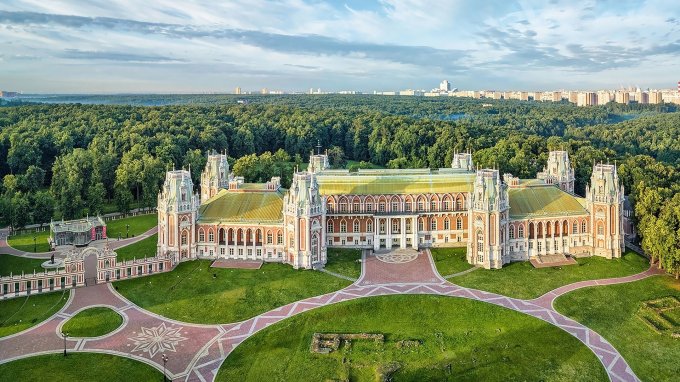
Moscow's largest palace and park complex is located in the south of the capital. The ensemble, built by order of Catherine II in 1776, includes a luxurious palace with exhibition halls and a park of almost 400 hectares. Today, Tsaritsyno is one of the most visited attractions in Moscow. The Neo-Gothic architecture, the light and music fountain, the richest collections of objects of decorative and applied art, paintings, furniture, royal dresses and weapons immerse the audience in the atmosphere of the second half of the XVIII century.
Kolomenskoye Museum-Reserve
Kolomenskoye Historical and Architectural Museum-Reserve is the former residence of Russian grand dukes and tsars. It is also located in the south of Moscow, not far from Tsaritsyno. From the center of the capital, Kolomenskoye can be reached by river boat.
The reserve has preserved unique architectural and historical monuments of the XVI–XVII centuries — the Tsar's Court, the Church of the Ascension, the church of the Kazan Icon of the Mother of God, the Church of the Beheading of John the Baptistand other buildings. Kolomna Wooden Palace, restored in 2010, deserves special attention.
Kuskovo Estate
To visit Kuskovsky Park and the famous manor museum, you will have to go to the eastern part of Moscow in the Veshnyaki district.
The heart of the park is the Grand Palace of the Sheremetev Counts. The one-story Russian Baroque building once hosted hundreds of guests who came to the residence for balls and feasts. Today there is a porcelain Museum and an art gallery.
There is a Large Palace Pond behind the main house. Interesting buildings have been preserved in the surrounding area — pavilions, houses, greenhouses, outbuildings and a temple with a bell tower.
Lefortovo Museum-Reserve
The formation of the ensemble in this area began with the appearance of the Lefortovo Palace (on 2nd Baumanskaya Street). The first building in Moscow, modeled on Western European architecture, was ordered by Peter the Great to be erected for his friend Franz Lefort. Later, Admiral General Fyodor Golovin built a manor house on the opposite bank of the Yauza River. His house later became the royal residence.
At the beginning of the 18th century, Lefortovo Park was in its heyday, it was even called "little Versailles." Unfortunately, not all the splendor has survived to this day. Today, the Lefortovo History Museum, the Rastrelli Grotto and the rotunda gazebo are available for tourists.
Vorontsovsky Park
Another old manor house is located in Vorontsovsky Park. Vorontsovo Nature Reserve will be interesting for those who are interested in the history and architecture of the XVIII–XIX centuries. The guests of the reserve are greeted by the towers of the "Turkish fortress" — this is the ensemble of the entrance gates of the Vorontsovo estate. Walking through the park you will see the Temple of the Life-Giving Trinity, the Cross of Worship, Italian and Chinese Gardens, Vorontsovsky ponds, park labyrinthsand other attractions.
Museum-reserve "Lyublino"
Historical expositions, antique interiors, musical and dance events, fascinating lectures and other events await everyone at the Lyublino Museum-Reserve.
The Palace and Park complex is known as a resting place for the Moscow nobility. The Lublino estate offers tourists to plunge into the atmosphere of that era: take a walk through the beautiful garden with lime alleys and fruit trees, go to the theater or explore the palace of Nikolai Durasov.
Izmailovo Estate
Izmailovo Manor on the island of the same name is a cozy green corner in the east of Moscow. Tourists come here to see the royal residence, the Bridge Tower and the Cathedral of the Intercession of the Blessed Virgin Mary.
Other popular Izmailovo attractions are adjacent to the island. Tourists with children are advised to visit the Izmailovsky Kremlin and spend a couple of hours in its museums and workshops, and then ride the rides in the Izmailovsky Park ofCulture and Recreation.
Sources