
What to see in Tsaritsyno Park
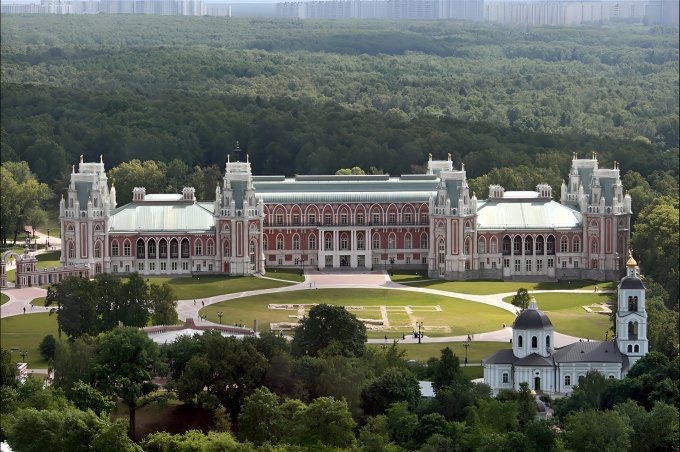
30 main attractions of Tsaritsyno Park
The main thing about Tsaritsyno
- Tsaritsyno is a natural and architectural complex in the Neo‒Gothic style in the southern part of Moscow.
- The complex was founded by order of Catherine the Great in 1776, but the Empress never lived there, although it is a worthy residence of the monarch.
- The complex includes a palace, a park ensemble, as well as huge exhibition halls.
- The museum complex consists of 18th-century expositions, an archaeological exhibition and a museum of applied and decorative arts.
- The picturesque and romantic landscaped park with sculptures and pavilions is an ideal place for walking.
- The largest light-dynamic fountain in Moscow.
What is it? Why do you need to see this?
Escaping from the bustling tourist streets to nature is a great plan at any time of the year when it's not raining. The 18th—century Tsaritsyno estate is not very far from the center, so coming there and walking through the park and palaces, boating and feeding the ducks is a great plan for a few hours, for example, after lunch and morning museums. Not so long ago, the park and palaces were restored and improved, concerts are often held in the evenings — it's comfortable and wildly interesting there, if you take an excursion, because this palace complex is known as the manor where no one lived.
The history of the Tsaritsyno Palace and Park Ensemble
The estate in the floodplain of the Gorodnya River to the south of the ancient capital belonged to the Romanov dynasty for several centuries. In 1775, the Empress bought the land from the descendants of Prince Cantemir for her own residence "in the taste of Gothic."
The construction of palaces, outbuildings, utility buildings and park amusements was entrusted to the famous architect Vasily Bazhenov. He has been working tirelessly on the task for 10 years, but the empress was not satisfied with the final result. Technically, it was because of the tightness of the premises. In fact, according to the creator's political views. Bazhenov became an active Masonic adept, and the Empress saw in the activities of the Moscow Masonic lodge a conspiracy against her authority.
Matvey Kazakov was assigned to continue the construction of the residence. He demolished the already finished main palace and built a new one, with exterior Gothic elements. Unfortunately, the aging ruler lost all interest in the Moscow residence: in 1791, her favorite and associate Grigory Potemkin died. After the death of Catherine herself in 1796, the heir Paul I ordered the work to be stopped completely.
The grandson of the Empress Alexander I, with the message "Everything will be like in his grandmother's time," ordered an amusement park to be opened to the public in Tsaritsyn. Wooden pavilions and gazebos were replaced with stone ones in the classical style. Under Alexander II, the area was given over to dachas. Most of the old buildings were falling into disrepair and falling into ruins.
Under Soviet rule, the large-scale restoration of the Tsaritsyno Palace and Park ensemble began only in the mid-eighties. By the beginning of the 21st century, small palaces and park facilities had been restored. In 2004-2007, the Grand Palace and the Bread House were recreated, the park was cleared of unnecessary trees and a light and music fountain was installed on the Middle Pond.
What to do in Tsaritsyn?
To walk in the park, to visit the museum on excursions or without, to attend concerts. Excursions, by the way, are carried throughout the park, including by electric vehicles. There are Tsaritsyn Ponds in the park, where boat rentals, sapboards and catamarans are now available. And in the forest there is a panda park, playgrounds, even a football field. Of course, locals mostly come to have a picnic, a photo shoot or a wedding walk, and go skiing in winter.
How much time do I need and when do I arrive at the museum-reserve?
It takes a couple of hours to get around all the buildings of the manor museum, especially with a guided tour, but most often people spend 3-4 hours in the park, and sometimes more when they go to nature and do something in the company - they don't really want to go back to the noisy center. The park is nice both in summer and winter, but it's better to go there in good weather. In any case, on weekdays there is a chance to get to maximum silence and solitude.
Where to stay?
To appreciate the beauty and historical heritage of Tsaritsyno, choose a hotel within the MKAD. The Maxim Panorama Hotel will be an excellent point to explore the best areas and main attractions of Moscow. Depending on which points on the map you want to visit, what kind of holidays, excursions and events you have planned, the MAXIMA HOTELS chain can offer comfortable rooms for tourists in the main districts of the capital:
- Maxim Panorama hotel: Masterkova St., 4. Avtozavodskaya metro station
- Maxim Zarya Hotel: 4 Hotel Street, building 9.
- Maxim Irbis Hotel: 1 Hotel Street.
- Maxim Slavia Hotel: Yaroslavskoye highway, 44. VDNKH metro station.
Top 30 — attractions of the Tsaritsyno Museum-Reserve
The Great Tsaritsyn Palace
It is the main attraction of Tsaritsyno. The construction of the palace took 11 years. Its architecture is represented by two styles – classicism and pseudo-Gothic, which makes it possible to call the palace one of the most significant buildings of the XVIII century. The palace consists of two wings – the chambers of the Empress and her son. They are connected by a majestic and eye-catching passage. The elegance of the palace is given by pointed arches and towers.
Light and music fountain and horseshoe Island
The island, supported on stilts, was created during the time of Catherine II. Since 2007, instead of a pond on the island, there has been a fountain, named by the residents of Moscow as the most beautiful in the capital. The diameter of the fountain is 52 meters, its 900 jets soar up 15 meters in the same rhythm with light and musical accompaniment. Hundreds of people come to see the magical and fascinating combination of water, light and music every day.
Tsaritsyn ponds
The cascade of Tsaritsyn ponds was formed for almost two centuries – from the XVI to the XVIII. The Upper One is considered the most beautiful, with an area of 17 hectares. Its artificial islands have regular geometric shapes and decorative plantings. The middle pond is separated from the Lower Pond by a dam designed by architect Blank. Boat marinas have been recreated in historical places here. There are places for recreation on the shores of ponds.
Tsaritsyn Landscape Park
It was founded in 1775. The regular garden was designed by architect Vasily Bazhenov and garden craftsmen from England, Yod Murno and Francis Reed. In 2005-2007, the park was completely renovated with the involvement of renowned landscape architects. In addition to restoring the original landscape views, many sculptural decorations have been installed in the park, including several grottoes. Gazebos and pavilions have appeared in the park.
Kitchen Building (Bread House)
It was built to accommodate kitchens in it. On the front facades of the building there are high-reliefs made in the form of a salt shaker and a loaf. The rooms of the Kitchen building have an enfilade structure. Currently, the museum's collections are displayed in its halls. The atrium is used for concerts and exhibitions, including organ music. The tool is made specifically for the Bread House in Germany.
Gallery-fence with gates
It was built at the end of the XVIII century. This decorative structure completes the ensemble of three royal palaces and a Kitchen building. The facades of the gallery-fences are richly decorated. The front side is decorated with columns and a white stone decoration of pyramid-shaped pinnacles and woven hearts. The gates have arches with spikes and two-tiered turrets. The architectural appearance of the gate gives the ensemble a solemn and complete look.
Monument to V. Bazhenov and M. Kazakov
The monument to the great architects who created the Tsaritsyno Estate was opened in 2007. It is located immediately after the arch of the Stone Gallery, between the Grand Palace and the Bread House. The author of the sculpture, Leonid Baranov, depicted the craftsmen at the moment of discussing the construction of the Grand Palace. The monument is popular with visitors to the museum-reserve, and there is often a queue of people who want to take pictures.
The First Cavalry Corps
A small one-story building is located on the edge of a large ravine. It has an L-shape. In 1988, under the leadership of the staff of the Polish restoration company, the original layout of the building was restored – three rooms from the front, the openwork parapet and the white stone pediment were updated. The building is decorated with a cocooned pediment and brick columns. Currently, the building houses the administration of Tsaritsyno.
Second Cavalry Corps
The pavilion has an octagonal shape. Thanks to her, the building has a unique layout – the rooms are connected to each other and the center. The rooms have exterior and interior doors. The building is built of red brick. Its decorations are the white stone decoration of the lancet high windows, plinth and cornice. Currently, the second Cavalier building houses the museum's art exhibitions, which attract a large number of visitors.
The Third Cavalry Corps
It was built in 1776-1779. It is located on a hill near the Middle Tsaritsyn pond. It differs in style from the First and Second Cavalry Corps. It has rounded exterior corners and tall windows. The building is crowned with an elegant belvedere tower. Part of the circular hall protrudes outward and forms a semi-rotunda. The Cavalier corps houses the exhibition "Dachnoe Tsaritsyno".
The Middle Palace (Opera House)
One of the most interesting buildings in Tsaritsyno with a complex decor. It was intended for small informal ceremonies and receptions of Catherine II. Its design is traditional for the overall appearance of the estate – the palace is built of red brick and decorated with white stone. The simple ground floor is topped by an elegant and intricately decorated second floor. A special decoration is an openwork arcade with images of sickles and disks.
Small Palace (Semi-circular Palace)
It was built for Catherine II personally. The six rooms of the palace include a boudoir and an oval hall. They are now used as exhibition halls. The location of the palace is very picturesque – on a high hill by the Tsaritsyn Pond next to the Figured Bridge. The building does not have a rich ornament, only its eastern facade is crowned with the imperial monogram. This monogram is used as the emblem of the entire Tsaritsyno estate.
Church of the Icon of the Mother of God "Life-Giving Spring"
The temple has a typical Elizabethan Baroque style – an octagonal shape topped with a faceted dome. It was founded in 1722 and has been rebuilt twice since then. During the reconstruction, the southern aisle was added to the temple, and the bell tower became three-tiered, becoming the dominant feature of the entire structure. The largest of the six bells has a weight of 180 pounds. The church has preserved Baroque stucco of the XVIII — XIX centuries and paintings of the XIX century.
Tsaritsyn dam
The largest preserved dam in Tsaritsyno. Earlier, the road from Kolomenskoye to the residence of Catherine II passed through the dam. Now the central alley of the park passes through the dam. The best way to assess the hydrotechnical characteristics of the dam is from the Upper Pond. From the side of the Middle Pond, the dam looks like a three-arch bridge. In winter, a large number of ducks gather near the drain.
Shaped bridge
It was built in 1776-1778 and is one of the few surviving buildings of the Tsaritsyno ensemble. The main alley of the museum-reserve passes through the bridge. The high towers of the bridge give it a look of reliability and stability. The bridge, like most of Tsaritsyno's buildings, is built of red brick with white stone decorations. It is located on a hillside and offers a beautiful view of the entire palace panorama.
A large bridge over a ravine
One of the best preserved large bridges of the XVIII century, with unique artistic features in the style of pseudo-Gothic. It doesn't look massive due to the decorations and decor that visually lighten it. At the same time, the bridge was not originally conceived to be so large. Due to the nature of the soil, more than 2,000 piles were driven during construction. During the Great Patriotic War, columns of tanks passed over the bridge.
Orangery Bridge
The author of the project is Ivan Egotov. The bridge was built in the 19th century, after Catherine's death. Then Tsaritsyno became a popular place for country picnics. The development of gardening in the park coincided with this. The bridge's functions are mostly economic – it connects the main territory of the reserve with greenhouses and large orchards. The decor of the bridge is modest, but it is designed in the general style of the Tsaritsyn ensemble.
Shaped (Grape) gates
They are located on the conditional border between the park and palace parts of Tsaritsyno. They were called curly by the author Bazhenov himself because of the large number of intricate shapes and patterns. The grape gate began to be called because of the white stone pattern in the arched opening, similar to a bunch of grapes. The gate's construction style combines artistry and solemnity. Currently, most of the gate's decoration has been lost.
The Milovida Pavilion
It is made in Empire style. The Milovida Pavilion is considered the most interesting of the pavilions built in the early 19th century. It is an elegant gallery consisting of four corner vaulted rooms. Inside it is decorated with columns and has painted vaults. The pavilion is built in a picturesque location, it offers a wonderful view of the Upper Tsaritsyn Pond with an island. Now the museum guards are stationed in the pavilion.
The Nerastankino Pavilion
The second name of the Nerastankino pavilion is the Temple of Melancholy. The pavilion was built in 1803 according to the design of Ivan Yerogov. This is a modest gallery with a low dome built in the classical style. In the 19th century, the pavilion, like many buildings in Tsaritsyno, became dilapidated and fell into disrepair. Its historical appearance returned only in 2007 during the reconstruction. At the same time, its sculptural decoration was only partially restored.
Gazebo "Temple of Ceres"
The gazebo was built in 1805. It is located on the south side of the landscape park, on a small hill. It was from here that Catherine II loved to watch the rural holidays. The gazebo was named after Ceres, the goddess of fertility, whose statue was installed in the gazebo immediately after construction. Currently, the gazebo is decorated with a modern statue, installed instead of the original sculpture that was broken during the war.
The ruined Tower
This building is called the most romantic building in Tsaritsyno. Currently, it is a dilapidated tower with fragments of white stone and brick walls. It was built in 1804. In those days, the construction of artificial ruins was in fashion. Because of the stairs leading to the crest of the northern wall, the tower was called the "Devil's Staircase" for a while. It is quite difficult to climb up and down it.
Arch-ruin on the island ("Rusalkin Gate")
It is located on an artificial island in the middle of the Upper Tsaritsyn Lake. A beautiful view of the arch opens from the side of the Nerastankino pavilion. The ruined arch looks especially impressive against the background of trees and water. According to legend, girls gathered on the lawn in front of her and danced in the mermaid week on the feast of Trinity. At the time of construction, the ruined arch had a tower, but it was not restored during the reconstruction.
Grotesque bridges
The arched bridges are located on the south side of Tsaritsyno Park. They connect the slopes of a deep ravine near the Nerastankino and Temple of Ceres pavilions. The bridges are built of brick, its white stone decor has rough stone inserts. All bridges have parapets, which eventually replace smooth white stone curbstones. During the construction in 1805, there were 3 bridges, by now only the Big and Small Bridges have been preserved.
Grape Greenhouse
It was built at the beginning of the 19th century specifically for growing the best grape varieties. During the decline of the Tsaritsyn estate, the greenhouse changed hands several times – dachas and communal apartments were located in it. After that, the white stone building practically turns into ruins. The greenhouse was restored on its historical foundation in 2008. Now grapes, figs, pomegranates, and agaves grow in it.
The first Greenhouse building
Currently, as in the 18th century, tropical and subtropical plants from different parts of the world grow in the building – hibiscus, pelargonium, blue passionflower, cycads, ivy, fuchsias. There are several palm trees. The winter garden looks especially beautiful during flowering. The original First greenhouse building was dismantled at the end of the 19th century. It was completely restored in 2008 during a large-scale reconstruction.
Burial mounds of Vyatichi
There are several burial mounds on the territory of the park in Tsaritsyno. In the 19th century, ancient burial grounds were perceived by visitors as romantic ruins. Vases and statues were placed among them. During major archaeological investigations, many burial mounds of the Vyatichi from the XI-XIII century were identified. Wooden sculptures of ancient Russian deities are currently installed near several mounds.
Foundations and fragments of the walls of a Large Cavalry Corps
The Bolshoi, also known as the fourth Cavalry Corps, was one of the main buildings of the Tsaritsyn Palace ensemble during its construction in 1782-1784. It was dismantled in 1795 due to the construction of the Grand Palace. The foundation and fragments of its walls are fenced off and attract little attention from visitors. This building occupies a central place on the memorial models of the Bazhenov estate project.
The foundations of the Gardener's House
The remains of the foundation were discovered in 2007. The building was built in the early 19th century. It is located in the Caretaker's Park and was presumably originally used as a bathhouse by the servants of Tsaritsyno Park. After that, it was equipped for the residence of employees of the landscape park. After several alterations in the 1970s, the house was finally dismantled. The white stone ruins are under special protection of the park administration.
The Visit Center
Since 2019, the Tourist Information Center has been a single space for visitors. For the convenience of guests, it combines all the basic services – in the visitor center you can buy tickets to exhibitions and museums, get background information about the services and work of the reserve. The shop of the visitor center has a wide range of products – a variety of souvenirs, travel guides to Tsaritsyno, educational literature.
How to get
Take the metro to Tsaritsyno or Orekhovo stations, and it will take 10 minutes to get to the park from there. The way from Orekhovo metro station is easier, and from Tsaritsyno you will get closer to the entrance to the estate.
By bus — Tsaritsyno Metro surface transport stops (1 min. walking distance), MCD Tsaritsyno (4 min. walking distance), Blood Center (8 min. walking distance), the Regional Theater of the Young Spectator (9 min. walking). You can get there by buses 814, 844, M89, C823.
By car — the car can be parked in paid parking lots at CHECKPOINT No. 13 (on Tyurina St.), checkpoint No. 3 (on 1st Radial St.), checkpoint No. 9 (entrance from Shipilovsky Passage).
- Address: Dolskaya St., 1, Moscow
- Opening hours: The park is open to the public from 6 a.m. to midnight.
- The museum has a day off on Monday, other days 10:00 – 18:00, Friday and Saturday 10:00 – 20:00.
- The greenhouses also have a day off on Tuesday, other days they work according to museum time. Contacts: +7 495 322-44-33
Cost: 1040 rubles for a package ticket.
The authorship of the photo, published without changes: , CC BY-SA 3.0