
Sights of the Moscow Kremlin
The pearl of Russia, the main decoration of the capital, is, of course, the Moscow Kremlin on Red Square. The best traditions of architecture and architecture, the beauty that has been preserved to our times in the form of a museum-reserve and a complex of historical and cultural significance. Despite the fact that the Annunciation and Assumption Cathedrals are one of the main parts of the museum, they continue to open doors to believers from all over Russia. And the world-class treasures, the Armory and the Diamond Fund, deserve special attention. It is also impossible not to mention Lenin's Mausoleum, St. Basil's Cathedral and the Grand Kremlin Palace.
Towers of the Moscow Kremlin
The first thing that tourists pay attention to is the 20 towers of the Kremlin. All of them are different - Kutafya tower has no definite shape, three more are rounded. All the others are rectangular. Stylistically, the towers overlap with each other, with the exception of Nikolskaya, which was rebuilt in the 19th century. But the Spasskaya Tower is well known to all residents of the USSR and Russia - it is under its chimes that we celebrate the New Year. They were installed back in the XV century!
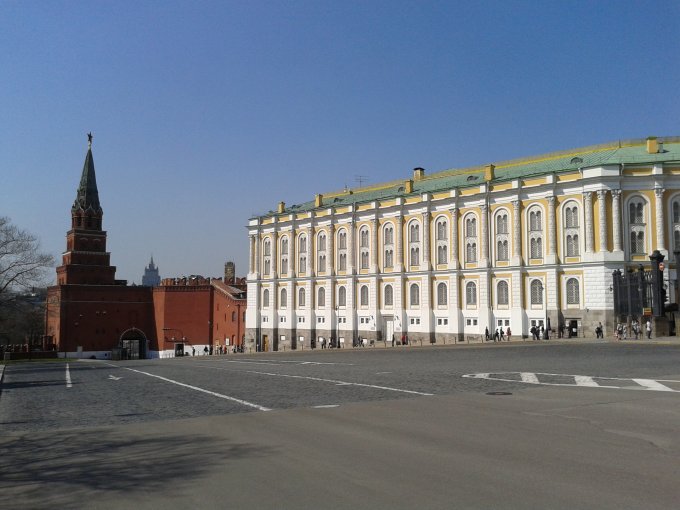
Armory Chamber
This museum, which everyone can visit now, was once a real royal treasury. It dates back to the 14th century. As a museum, the Armory has existed since the 19th century, and at first only very distinguished visitors could come there.
Now the situation has changed. Everyone can look at silver and gold items, armor, weapons, icons, royal symbols of power and many other attributes of this large-scale exhibition. The collection features both Russian and foreign masters from different years.
Assumption Cathedral
The only building that has come down to us in almost the same pristine condition as when it was built is the Assumption Cathedral of the 15th century.
This building was built after the order of Ivan III. The first stone of the cathedral was laid back in 1472, but the construction had to be temporarily postponed because a strong earthquake began. What had already been built was irretrievably destroyed. The side walls turned out to be too thin, the mortar was of too low quality, which led to the collapse of the arches.
The great architect Aristotle Fioravanti came to the rescue from Italy. It was thanks to him that what we see now appeared - a white stone structure reinforced with steel piles. Facades began to be highlighted with projections, arches were laid out. And all this in a very short time at that time.
Already in 1479, the cathedral was completely finished. In August of this year, a solemn ceremony was held, the temple was consecrated and opened to visitors.
For many years, it was here that kings were crowned, and nobles were crowned. There was also the tomb of almost all the Moscow patriarchs. The only exceptions were Ignatius and Nikon.
Over the years, the Assumption Cathedral has suffered from fires and its own antiquity more than once, but thanks to the efforts of specialists, it has remained exactly the same as when it was built. The frescoes and murals have not changed since the 15th century, but there are many more parishioners - many come here to worship the relics of the saints and see with their own eyes the gunpowder that once belonged to Metropolitan Peter.
The Assumption Cathedral still receives visitors. You can either come on your own or take part in an excursion.
Tainitsky Garden
It is not known exactly when the garden of the same name appeared next to the Tainitskaya Tower. Historians suggest that the appearance of this garden was between the 14th and 19th centuries. You can get into it if you walk close to the southern Kremlin wall.
This garden will delight visitors with a variety of flora and fauna. Where else in the city center can you find falcons, owls and hawks? Poultry houses are organized for them. You can walk for hours between the fir and juniper alleys. And you should definitely see the Cosmos oak, which was planted by Yuri Gagarin himself in 1961. Lilacs and apple trees bloom here, and the park is incredibly transformed in spring.
Paths, like rays, run in different directions, you can easily walk around the entire park and admire the fountains and flower beds. For many years, the Tainitsky Garden has been a favorite place for recreation not only for guests of the capital, but also for local residents.
The Senate Palace
Connoisseurs of classicism in architecture will like the Senate Palace, which was built at the end of the XVIII century by M.F. Kazakov. The construction of the palace was initiated by Catherine the Great, it was originally planned that Moscow nobles would gather here, but later the building was given over to local governments and the District Court.
At the beginning of the 20th century, the leader of the proletariat, V.I. Lenin, settled here. The place where he lived and worked is now part of the museum exhibit. It was also in the Senate Palace on the ground floor that I.V. Stalin lived, and later MikhailS. Gorbachev received apartments here on the third floor.
The interior of the palace was constantly changing - new offices and rooms were added, which for the most part now have the status of museums. But some halls are still in operation, meetings are held there. In addition, you can visit the library, which contains many unique books, historical and political documents.
Annunciation Cathedral
This temple was built at the end of the XV century on the site of another wooden temple. A unique historical building - the great Andrei Rublev created here. His icons are considered to be among the most valuable. And the temple itself is painted inside by famous artists, for example, Fyodor Yedikeev. Currently, a museum expedition located in the basement of the temple is also available to visitors. The "Treasures of the Moscow Kremlin" consists of various rarities, jewels and much more that were found during excavations and restorations.
The Bell Tower of Ivan the Great
At the beginning of the 16th century, the bell tower of Ivan the Great appeared on the territory of the Kremlin. Previously, it was near her that the heralds read out the royal orders and decrees to the people. After 500 years, the building was restored, now everyone can climb to the height of the 5-storey building and see the bells firsthand. Each of them has its own name, they were cast at different times. The first of them was created by the time the construction was completed, but the last one dates back to the 19th century.
The Tsar Bell
A real piece of foundry art that has never left the earth. The bell was created in the XVIII century, it was cast near the place where it is located to this day. It never rang, it was not installed in the bell tower. Almost from the very beginning of its creation, various troubles awaited the foundries - fires, diseases. The chief caster also died. And, of course, we must not forget about the famous crack - it appeared because water got on the hot metal.
Tsar Cannon
The almost 40-ton piece of weapons art was created at the end of the 16th century. The length of the Tsar cannon is five and a half meters, it was cast here, in the workshops of the Kremlin. It was never used for its intended purpose, although it was put on alert once when the Crimean Khan approached Moscow. Currently, the cores that are located next to the Tsar Cannon are not real, they are empty inside and only complement the composition.
Patriarchal Chambers
The Chambers are a complex of buildings that have long been the residence of metropolitans and patriarchs since the middle of the 17th century. The palace was created by Russian architects, A. Konstantinov and B. Ogurtsov.
Now visitors to the Kremlin can see there is a huge exhibition of applied art, as well as household items that were used in the 17th century. Here you can also see the personal belongings of the ruling dynasty, books, jewelry, icons and much more.
Photo source, published unchanged - By C.caramba2010 - Own work, CC BY-SA 3.0