
Zamoskvorechye sights
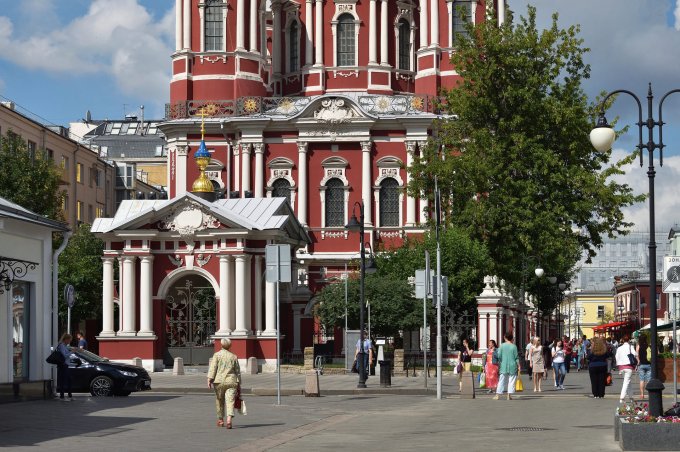
One of the most atmospheric areas of old Moscow, Zamoskvorechye, is located in a wide irregular crescent on the bank of the Moskva River opposite the Kremlin. The history of this area has been going back for more than six centuries – but time here seems to be in no hurry at all: he leisurely strolls through the picturesque alleys under the crowns of century-old poplars, relaxes in cozy squares with fountains and enjoys the silence of the capital.
Ivan Shmelev and Alexander Ostrovsky called Zamoskvorechye their small homeland, Leo Tolstoy, Fyodor Dostoevsky and Anna Akhmatova visited, lived and stayed here. The number and quality of its attractions could well be the envy of a medium-sized European city: the Tretyakov Gallery, the Marfo-Mariinsky Monastery, writers' houses, art and historical museum collections, squares, fountains are located in Zamoskvorechye... Due to the fact that in the 1960s and 70s the area was given the status of a nature reserve, the historical buildings of the 18th and 19th centuries have been perfectly preserved here - literally every mansion is an architectural monument.
Geographical educational program
The modern borders of Zamoskvorechye differ from the historical ones. Thus, its original geography included the area south of the Moskva River up to the borders of the Zemlyanoi City (present-day Garden Ring). Today, the Zamoskvorechye administrative region refers only to the eastern part of this "crescent", bounded on the west by the Bolshaya Ordynka. But the southern border has noticeably moved away, joining the area of Paveletsky railway station, Dubininskaya, Lyusinovskaya and Mytnaya streets. However, the historical concept of Zamoskvorechye is still used in guidebooks around Moscow and on excursions.
A bit of history
The first name of the district, under which it is mentioned in the chronicles of the 14th and 15th centuries, is Zarechye. Isn't it true that this very name conveys rustic artlessness, patriarchal peace and the regularity of the flow of life? The way of life of its inhabitants was to match: they started and ended the day early, and in the evenings they drank tea in courtyards or at open windows, certainly in front of a huge samovar. The people who settled in Zarechye were mostly ordinary people: blacksmiths and tanners, sheepskin workers, interpreters, archers...
The names of Zamoskvoretsky streets remained as memories of the first centuries of the district's existence: for example, tribute collected from the Russians was transported along Bolshaya Ordynka to the Horde, and the lively Pyatnitskaya shopping street was named after the church of St. Paraskeva, whose name means "Friday" in Greek. In the 17th century, due to the cheapness of the land, Zamoskvorechye was chosen by merchants for the construction of estates, warehouses and courtyards – so whole estates with extensive gardens and vegetable gardens began to appear here. Up to the beginning of the 19th century, the district consisted of separate large neighborhoods, where merchants, burghers and artisans settled. The atmosphere of patriarchy, provinciality and tranquility attracted both representatives of the ancestral nobility and creative people to Zamoskvorechye, whose estates remain the pearls of the district to this day.
The 20th century radically changed the appearance of Zamoskvorechye: many temples were destroyed, metro stations and modern wide highways appeared, and a House was built on the embankment. Well, among the most recent attractions of the area are the complex of buildings of the House of Music, the monument to Peter I and the New Tretyakov Gallery on Krymsky Val.
TOP 5 places worth visiting first
The main attractions of Zamoskvorechye are temples, museums and houses of famous Russian writers. A pleasant addition to the famous places is the indescribable atmosphere of the area: low buildings (as low as possible in the 21st century), an abundance of greenery, small merchant estates. It is good to wander along the Ozerkovskaya and Ovchinnikovskaya embankments: from there you can enjoy a beautiful view of the canal and the industrial districts. The quiet lanes of Zamoskvorechye are also good: for example, Runovsky and other (unnamed) branches from Bolshaya Tatarskaya. With the onset of spring, they become even more beautiful, and the proximity of water adds some kind of suburban-urban chic to the area. Let's talk about the most popular places that you can't miss while walking around Zamoskvorechye.
If you don't have much time for sightseeing, spend it visiting the main locations of Zamoskvorechye.
The Tretyakov Gallery, or simply the Tretyakov Gallery
One of the most famous art museums in Russia. It houses one of the world's largest collections of Russian fine art. The gallery was founded in the 19th century by Pavel Tretyakov, a local philanthropist and merchant. One of the first paintings in the collection was "A Skirmish with Finnish smugglers" by Vasily Khudyakov.
During the Great Patriotic War, the paintings and other exhibits of the Gallery were evacuated to Novosibirsk. From 1986 to 1995, the Tretyakov Gallery was closed for restoration.
The gallery regularly hosts exhibitions of global importance (for example, recently they brought wonderful collections of paintings by Serov, Aivazovsky, and the Vatican museums). Important: the gallery has a second building at 10 Krymsky Val. Some interesting exhibitions take place there. Don't confuse it.
- Address: Lavrushinsky lane, 10.
- Opening hours: daily, except Mondays.
- Tuesday, Wednesday, Sunday – from 10 a.m. to 6 p.m. (ticket offices and entrance until 5 p.m.)
- Thursday, Friday, Saturday – from 10 a.m. to 9 p.m. (ticket offices and entrance until 8 p.m.).
- Entrance ticket for adults – 500 rubles, for seniors – 300 rubles, for children and teenagers under 18 years of age – 250 rubles.
The Church of Clement the Pope
This magnificent Baroque building is the largest temple in Zamoskvorechye. It was built at the expense of a local merchant Kuzma Matveev. The first written mention of the temple dates back to 1612. It was very rare for such large, pompous temples to be built in the area.
During the Soviet years, books from the collection of the Lenin State Library were kept in the church. It was only in 2008 that the last books were removed, and the church was finally handed over to the Orthodox community.
The church is named after St. Clement for a reason: it was he who was the first revered saint in Russia after her Baptism. Clement, who was born a real Roman, was exiled to the Crimea due to various vicissitudes. There he worked at the Inkerman quarries, and eventually created a large Orthodox community in Chersonesos.
- Address: 26/1 Pyatnitskaya St.
- Opening hours: daily from 8:30 to 19:30.
- Worship services and liturgies are held regularly. Admission is free.
The Red Church, also known as the Church of Gregory of Neocaesarea
One of the most beautiful and elegant churches in Zamoskvorechye. It is notable for the fact that the future Emperor of the Russian Empire, Peter the Great, was baptized here.
Built in the 15th century, the church was initially wooden. In the 17th century, it was rebuilt in stone. The architects were people with memorable names: Karp Guba and Ivan Grasshopper. The walls were painted by the then famous icon painter Simon Ushakov.
In Soviet times, the bell tower of the church wanted to be demolished, as it interfered with the expansion of the pedestrian sidewalk. However, the townspeople defended the construction, and the authorities limited themselves to punching an arch in the bell tower. Now it is a kind of "trick" of the church.
- Address: 29A Bolshaya Polyanka Street
- Opening hours: daily from 9:00 to 20:00
Marfo-Mariinsky Monastery
Who would have thought that turning off Bolshaya Ordynka grayish street through a gate with a small gate, you could find yourself in the Garden of Eden? The Marfo-Mariinsky Monastery owes its origin to the Grand Duchess Elizabeth Romanova, who in 1909, after the death of her husband, sold all her jewelry and bought a huge estate with a beautiful garden with the proceeds. The monastery had a hospital, a pharmacy, a library, a canteen, a shelter for children – and all this was free.
The main dominant feature of the monastery is the snow-white Pokrovsky Temple, built in the Novgorod style. It is very concise and simple, there is nothing superfluous in it. The monastery was opened only in 2009 after a large-scale restoration. Now it is an active women's Stavropol monastery.
A curious fact: Ivan Bunin's novella "Clean Monday" describes the Martha and Mary Monastery: the main character, a beautiful girl who lives opposite the Kremlin, goes there on a Forgiven Sunday.
- Address: 34 Bolshaya Ordynka St.
- Opening hours: daily from 8:00 to 19:00
Alexei Bakhrushin Theatre Museum
This unique museum will appeal even to people who are far from the theater. It was founded in 1894 by Alexei Bakhrushin, a Moscow industrialist, philanthropist and philanthropist. His former home, a beautiful Gothic-style building, now houses a theater museum.
It is considered to be the largest theater museum in the world. His collection includes – just think about it! – one and a half million exhibits.
Alexey Alexandrovich loved a beautiful life. During his travels abroad, he always visited antique shops, where he found valuable exhibits for his future museum. Among the curious items are the manuscripts of Griboyedov, Chaliapin, Nemirovich–Danchenko, gilded theatrical helmets, ladies' shoes of the XVIII century, dresses of great actresses, models of various theaters.
- Address: 31/12 Bakhrushina St.
- Opening hours:
- Tuesday, Saturday, Sunday – from 12:00 to 19:00
- Wednesday, Thursday – from 13:00 to 21:00.
- The entrance fee is 150 rubles. Discounted ticket – 125 rubles.
Visit other interesting locations in Zamoskvorechye
The ideal option for checking in to feel the spirit of Zamoskvorechye is the Maxim Panorama Hotel. Just one minute from Avtozavodskaya metro station and you get the most comfortable location to explore the best locations in Moscow. The 4–star hotel offers superior single and double rooms, studios, as well as business and junior suites. This is an ideal combination of remoteness from attractions, location quality, optimal cost and service.
The system of courtyards between Pyatnitskaya and Ordynka
It's a confusing system that takes you back in time to the distant 19th century. The former Yeremeyev estate is located here in the possession of the Savvino-Storozhevsky Monastery and the church. Previously, these courtyards housed 19th-century apartment buildings, but now their place is occupied by small offices. There is peace and quiet here – you can take a secluded walk or sit with a book in your arms.
Bolotnaya Square
Bolotnaya Square is a large park on an island between the Moskva River and the Drainage Canal. In the old days, fist fights took place here, which were even attended by the sovereigns. In addition, State criminals were executed in this square. Today, the square is a gathering place for young people, members of informal subcultures, drummers and fire fighters.
At one end of the square, at the entrance to the square, there is a large fountain with strict columns and cast lattices; at the other end of the square there is a sculptural composition "Children are victims of adult vices", and in the central part of the square there is a large flower garden and, facing the Moscow River, a monument to Repin. Well, from the Bolotnaya embankment there is a magnificent view of the fountains installed in the Drainage Channel, which are especially beautiful at night due to the multicolored lighting.
Ovchinnikovskaya embankment
A small but very beautiful embankment stretching between Pyatnitskaya Street and Runovsky Lane. The embankment is notable for its buildings, mostly built in the 17th and 18th centuries. The writer A. N.Ostrovsky wrote that only here you will see the "reserve" of the merchant Zamoskvorechye. Indeed, it seems as if the spirit of the past still lingers in the alleys that overlook Ovchinnikovskaya Embankment, those times when disgraced merchants lived here, the mores of whose descendants Ostrovsky satirically showed.
Writers' House
The house, located directly opposite the Tretyakov Gallery, at first glance seems gloomy and unattractive. The building with its black marble porch, multi-level roof and a number of massive balconies is, however, one of the most striking examples of Stalinist buildings. Muscovites know it as the Writers' House. The list of writers who have received apartments here cannot fail to impress: Boris Pasternak, Ilya Ehrenburg, Agnia Barto, Ilya Ilf and Evgeny Petrov, Konstantin Paustovsky, Mikhail Prishvin, Veniamin Kaverin, Yuri Olesha, Lev Kassil...
It was the house in Lavrushinsky that became the famous "Dramlite", where the critic Latunsky, hated by Margarita, lived, who ruined the Master. Having become one of the symbols of the gloomy Stalinist era, House 17 now peacefully coexists with buildings from different eras. If you go into his courtyard, you can see the chambers of the late 17th century in the corner, and in a quiet square from the facade in Lavrushinsky there is a small but cute Fountain of Arts.
House on the Embankment
The famous house, which was inhabited by representatives of the party elite in Soviet times, is famous, firstly, for its architecture in the style of the Soviet avant-garde, and, secondly, for a number of tragic stories related to its residents. In addition to the department store, kindergarten, savings bank branch, gym and other amenities, the house also had a number of safe houses where security officers lived.
With such neighbors, the residents of the house could not feel at ease; many were repressed by whole families. Today, the house has been declared a historical monument and is protected by the state.
Chambers of Averky Kirillov
Averky Kirillov's Chambers on Bersenevskaya Embankment are one of the few surviving stone residential buildings from the middle of the 17th century. The history of this unique house is full of mysteries and mysteries. The surviving information about the construction of the chambers and their owners is sketchy and often based on legends and traditions, for example, about secret underground passages that connect this building with the Kremlin.
Some historians consider the Duma nobleman Ivan Bersen-Beklemishev to be the first owners of the city estate, while others believe that the courtyard of the famous historical figure Malyuta Skuratov was here. The first documented owner of the estate is a wealthy merchant Averky Kirillov. The chambers form a single architectural complex with the Church of St. Nicholas the Wonderworker and office buildings along the embankment. Look for the famous chambers at 18c3 Bersenevskaya Embankment.
Temples of Zamoskvorechye
The Church of the Resurrection of Christ in Kadashi has been known since the end of the 15th century. The modern stone building was built at the end of the 17th century by the efforts of the inhabitants of Kadashevskaya Sloboda – coopers and weavers. This is one of the most remarkable temples in the Zamoskvorechye region, with its five graceful domes, a 43-meter slender bell tower and the airy lightness of the Moscow Baroque style.
The Church of the Beheading of the Head of John the Baptist near Bor is one of the oldest temples in the region: it was erected in 1514 on the site of the relocated Ivanovsky Monastery, at a time when Borovitsky Hill was covered with forest (forest). The temple is a real treat for the eyes due to its eclectic appearance, which combines features of Baroque and classicism. For example, the bell tower's tiers are supported by columns with 3 types of classical capitals.
The Church of St. Nicholas in Tolmachi is part of the Tretyakov Gallery building complex. In fact, it is both an active temple and an exhibition hall at the same time. The church's decorations, iconostases and utensils are part of the museum's collection, but services are also held here.
The temple is definitely worth a visit to admire the icon of the 12th century. "Our Lady of Vladimir" is one of the most revered Russian shrines. The Church of St. Michael the Archangel in Ovchinniki was built in the early 17th century and has been rebuilt several times. Its main altar was consecrated in honor of the Intercession of the Virgin, whose icon was a temple icon for a long time until it was lost in the 1930s. The Moscow patterned style endowed the appearance of the temple with a wealth of artistic details and lightness: there are tiers of figured tiles, intricate window hoops, and elaborate stucco molding.
The Church of St. Nicholas in Pyzhi was built in the middle of the 17th century. This is one of the most amazing temples in the Zamoskvorechye region: in its luxurious but refined appearance, a tent–shaped bell tower, tiers of elegant kokoshniks and five miniature domes attract attention, and inside there are ancient icons with faces darkened by time and valuable temple relics.
Zamoskvorechye Museums
The Tolstoy Center on Pyatnitskaya Street, a branch of the State Museum of Leo Tolstoy, occupies a late 18th-century manor house, one of the buildings of which was rented by young Tolstoy in 1857-1858 after returning from the Crimean War. The center regularly hosts themed exhibitions from the collections of the united Museum and musical evenings. Address: 12 Pyatnitskaya St.
The Moscow Streltsy Museum tells about the inhabitants of Zamoskvorechye under Ivan the Terrible. In the halls of the 17th-century clerical chambers with low ceilings, thresholds worn out over the centuries and narrow windows, items of uniforms and weapons of the archers are presented, their peaceful life and military exploits are described.
In the interactive part of the museum, you can try on a warrior's costume, hold sagittarius weapons of different years in your hands, try to fire a musket or play a battle signal on a drum. The Kadashevskaya Sloboda Museum is located in the annex of the Church of the Resurrection of Christ in Kadashi. Its exhibits tell about the way of life, traditions and culture of the original inhabitants of the Zamoskvorechye Kadasha – merchants of wood chips and wooden goods. Visitors seem to be transported back to the childhood of Ivan Shmelev: right in the middle of the exhibition hall stands an exact replica of the Kadashevskaya hut, and around there are a lot of curious objects of that era.
The Museum of Tropinin and Moscow Artists of his time occupies 4 halls of an old mansion in Shchetininsky Lane, one of the few surviving merchant estates in Moscow in the 1830s. The collection of 3,000 items is based on paintings by V. A. Tropinin, his students, followers and imitators; in addition, the museum presents authentic interior items of that time.
Fountains of Zamoskvorechye
There are no historical fountains in Zamoskvorechye – all existing compositions decorated the area relatively recently.
The Adam and Eve fountain in the park in front of the Novokuznetsk metro station lobby depicts the ancestors of mankind under the tree of knowledge, in the company of the omnipresent serpent. Matte bronze is combined with gilded details – individual leaves in the crown of the tree and silhouettes of birds of paradise. The fountain is surrounded by comfortable benches, where it is pleasant to relax under the soothing sound of water jets.
The Fountain of Arts is located in Ivan Shmelev Square in front of the Writers' House, not far from the Tretyakov Gallery. On the granite base there are gilded picture frames depicting bronze landscapes. The silence of the square is almost not disturbed by the barely audible murmur of water.
The fountains on the Drainage Canal are a real pole of attraction for the newlyweds, who not only arrange picturesque photo shoots here, but also hang a symbolic lock on the "tree of love". However, even if you are not a newlywed couple, you should definitely visit the fountains: lush bouquets of jets of different heights and shapes look very impressive right on the surface of the canal.
Practical information
Metro stations in Zamoskvorechye are Tretyakovskaya and Novokuznetsk (the center of the district), Polyanka and Oktyabrskaya (the western part), Dobryninskaya, Serpukhovskaya and Paveletskaya (the southern part).
Zamoskvorechye in one day
If you are passing through Moscow, but you are eager to visit Zamoskvorechye (which is very right, because here you will feel the true spirit of the capital much more vividly than on Red Square), follow the suggested route. Thanks to him, you will see all the most basic and even a little more.
10:00 a.m. – you left the Polyanka metro station. Move along Bolshaya Polyanka Street in the direction opposite to the center.
10:30 a.m. – soon you will see a bright high temple on the left – this is the Cossack Church. Officially, it is called the Church of the Assumption of the Blessed Virgin Mary in Kazachya Sloboda. This temple is notable for the fact that in the 17th century it was built at the expense of ordinary citizens. During the Soviet years, the top of the bell tower was broken. Now the church is open daily, and there is a Sunday school.
11:00 a.m. – turn into 1st Kazachiy Lane and walk 500 meters to house No. 6. It is unique because the owners have preserved the wooden building of the 19th century. You won't be able to get into the territory, but you can look through the fence gap.
11:30 a.m. – moving on to Shchetininsky Lane. The museum of Tropinin and Moscow artists of his time is located in house No. 10. It is located in a typical merchant's mansion of the late 19th century. The museum's collection contains paintings by Bryullov, Kiprensky, Rokotov and, of course, Tropinin himself. The museum is small, so we recommend taking a look: it won't take much time. It is open daily except Mondays. Tuesdays, Wednesdays and Sundays from 10:00 to 18:00, Thursdays from 13:00 to 21:00, Fridays and Saturdays from 12:00 to 20:00.
13:00 – after the museum, we return to 1st Kazachiy Lane and walk towards Bolshaya Ordynka. After leaving it, turn left and walk to house number 36, where the Marfo-Mariinsky Monastery described above is located. In good weather, you can spend about an hour walking along the garden paths.
14:00 – after visiting the monastery, we continue along Bolshaya Ordynka and soon reach the Tretyakovskaya metro station. On the left will be the giant Rosatom building. Next, we have several options: go to the Tretyakov Gallery, have lunch, or take a leisurely stroll through the streets of Zamoskvorechye. You can go for a walk. In this case, we go through the subway and continue along B. Ordynka. Soon you will see on the left the Church of the Icon of the Mother of God of All the Sorrowful Joy. This place is bright and kind, you can often get to a christening here or just relax in a shady courtyard. Anna Akhmatova also loved to pray here.
15:00 – we reach Chernigov lane and dive into it. Here you seem to get lost in time and space. Either this is St. Petersburg, or a small county town of the last century. We pass through the twists of the alley and find ourselves on Pyatnitskaya Street, which is usually crowded. Fortunately, the pedestrian sidewalks were expanded a couple of years ago and now walking along it is a pleasure.
16:30 – after lunch we continue along Pyatnitskaya. We have to walk almost the entire street, but all the better: do not forget to look around, because soon on your left you will see the Novokuznetsk metro station and the Adam and Eve fountain in front of it, and a little later, on the right, the already familiar St. Clement's Church.
17:00 – when you reach the house number 50 on Pyatnitskaya Street, stop. In front of you is the Reck mansion, or, as the townspeople call it, the lion house. It was built at the end of the 19th century by order of Wilhelmina Reck in the eclectic style, or, according to some architects, in the Rococo style. After admiring the unusual building for Zamoskvorechye, we go back a little and dive into 2nd Novokuznetsk Lane.
17:30 – soon you will see an unremarkable light brick building (house number 13/15) on the right side. If you are lucky, you will feel the subtle aroma of chocolate and sweets even earlier. This is the confectionery factory "Mouth Front". It was founded by the merchant brothers back in 1826, initially caramel was produced there. It is noteworthy that the factory received its name (translated from German, its name means "red front") as a sign of solidarity with the German communists. It was in 1931, just ten years before the outbreak of the Great Patriotic War. "Mouth Front" became the first factory in the USSR to start producing chewing gum – you must admit, in 1980 it was a breakthrough. All in all, it's a curious place. Also because there is a company store where you can buy all the candies produced at the factory. The store is open daily, from 8:00 to 20:00.
18:00 – we go out onto Novokuznetsk Street and walk towards the Garden Ring. On the right, at number 38, you will see a red squat temple building. This is the Ancient Orthodox church in honor of the Intercession of the Most Holy Theotokos, or, more simply, the church of the Old Believers. You can go inside regardless of religion. It seems that you have been thrown back several centuries. And all this is in the center of Moscow. The temple is open daily, from 7:00 to 19:00.
18:30 – if you walk a little further after the temple, you will see the Paveletskaya metro station on the left. You can turn left along Sadovoye and go to the canal embankment. Or you can take the subway and go for a walk in the alleys of Kitay-gorod, for example. Because that area is for fun, and Zamoskvorechye is for the soul.
We hope that a walk through Zamoskvorechye has left the warmest feelings in your soul. In this route, we visited only the most significant places of the district, which means that it is worth returning here more than once to better understand the spirit of old merchant Moscow.
Photo source, published unchanged - Authorship: Ludvig14. Own work, CC BY-SA 4.0