
Interesting facts about MSU
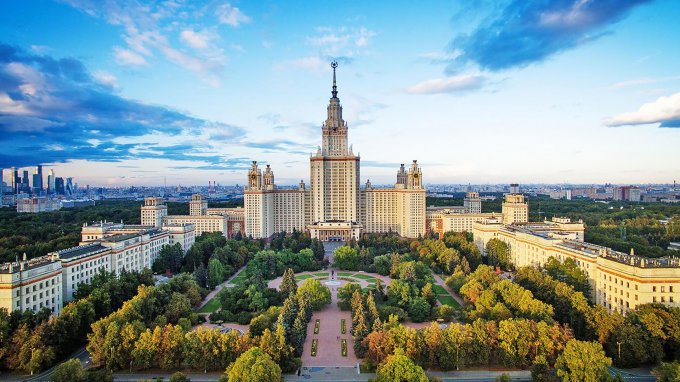
The main building of Moscow State University has been around for more than half a century, and during this time, many myths and legends have accumulated around it. Some talk about freezers for freezing the soil under the building, while others talk about the statue of Lenin on the steeple of the GZ.
The largest clock in Russia is located on the main building.
It's even kind of awkward in front of the Spasskaya Tower. Do not confuse: the Kremlin chimes are the oldest in Russia, but they are smaller than the structures on the University high—rise. The diameter of the dial is nine meters, which is almost three meters more than on the Red Square.
The clock was built in 1953, as was the entire university. The length of the minute hand is 4.2 meters, and it weighs 39 kilograms. The hour hand is 50 cm shorter and 11 kilograms heavier than the minute hand. We are talking specifically about mechanical watches.: There are more digital clocks, for example, on the tower in Moscow City, but we are not interested in them.
The skyscraper was planned to be built on a cliff
The building was designed by architect Boris Iofan: a tall tower with a spire in the middle and four identical turrets on the sides is his idea. According to the original plan, the high—rise was supposed to be located on the edge of the Vorobyovy Gory, where the observation deck is now.
Foundation specialists were seriously afraid that the ground under the multi-ton building would collapse, but Iofan did not agree to move the location of the project. As a result, the architect was suspended from construction, and Lev Rudnev took his place. Under Rudnev's leadership, construction was moved 800 meters further from the edge of Vorobyovy Gory.
A building for "undemanding" faculties
The MSU high—rise is, of course, a symbol of the university, but already at the design stage it became clear that it was of little use for "serious" faculties. It was originally planned to transfer teachers and students involved in the exact sciences to Vorobyovy Gory. The humanities could not develop an atomic bomb or create new technologies, which means it was not shameful to leave them in the old building.
At the same time, the chemistry department needed separate ventilation and sewerage, while the physics department needed a low—rise building with a good foundation for accurate measurements. The management of these schools strongly disavowed the skyscraper. As a result, the geographical, geological and mechanical-mathematical faculties became the first inhabitants of the skyscraper. The rest of the premises were given over to museums, dormitories and apartments.
All students started their studies at the Faculty of Philosophy
As Lomonosov conceived, initially all MSU students were supposed to enroll in the Faculty of Philosophy. In his opinion, everyone needed to receive basic training in the field of humanities. Later, students could transfer to another faculty or stay at the current one.
An interesting fact: at that time, Moscow State University was already different from its foreign counterparts. Theology was widely taught in universities around the world, but in a secular state it was decided not to introduce this subject into the curriculum. In the first year, absolutely all students studied for free. And the most gifted could not pay for their studies afterwards, regardless of the faculty.
Apple tree alleys were created thanks to Stalin
After the university was built, Joseph Stalin asked himself the question: what should be planted on its territory? He asked the designers about this. At the same moment, the chief offered apple trees. There were no objections, and the project was approved.
Any Muscovite, as well as a guest of the capital, can enjoy apples for their own pleasure and for free. Not only students and teachers have this opportunity. Recently, the alleys have received the unofficial folk name "our Poland".
A hotel was supposed to stand on the site of the main building of the Moscow State University.
In 1947, on September 7, when Moscow celebrated its 800th anniversary, 8 projects of famous Moscow skyscrapers were laid. The Council of Ministers of the USSR issued a decree "to build a 32-story building on Lenin Hills and place a hotel and housing in it."
It can be seen from here that initially there were no plans to build a university on this site. However, in March 1948, a clarification appeared: "In the period from 1948 to 1952, to build a new building for Moscow State University on Lenin Hills."
The "smart house" of the 50s and triangular rooms
It is not easy to organize a huge space so that it is suitable for study and life. The engineers of the 50s thought out the ventilation, heating and dust extraction systems in detail. So even in triangular cubicles (yes, there are some in the Moscow State University high-rise because of its complex architecture), a comfortable temperature is maintained. The ribbed surface of the towers made it possible to make more window openings and create bright rooms, even if they are small student rooms. Elevators reaching the upper floors of the building are another rarity of the era, in the early 50s they were enough to prevent pandemonium in the halls.
In large professor's apartments, a maid's room and a separate kitchen with a personal garbage chute were originally conceived. The latter brought a lot of problems, and the tenants tried to get rid of it. Terraces and outdoor solariums were planned on the upper floors, which, however, were almost immediately converted into additional living spaces.
A city within a city
The stories that students did not leave the university for months in the 1950s and 1960s are based on a rather prosaic fact: many young people simply did not have winter clothes. However, this does not negate the fact that now most of the main university building is occupied by dormitories, where teachers also live. There is also a canteen, a cultural center, a swimming pool, and even a home and clinic.
Bomb shelter
There are many legends about Stalin's skyscrapers and Moscow State University. One of them says that under the Main Building there is a real underground city, which even has its own metro line. In fact, there is a huge bomb shelter for university students and teachers. Unfortunately, the documentation and maps of the bomb shelter have not been preserved: kilometers of tunnels remain unexplored, many doors are tightly sealed and no one knows how big the bomb shelter really is.
The mysterious basements of the Main Building of Moscow State University
Lenin Mountains, 1
The main building of Moscow State University is the tallest of the seven Stalinist skyscrapers. It was built on the banks of the Moskva River, on Vorobyovy Gory. The university building became one of the architectural dominants of the capital: in the 1950s, the skyscraper was visible from almost all areas of the city.
Most of the legends about the building are connected with its basements. According to rumors, the project could not be coordinated for a long time: the soil on Vorobyovy Gory was too unstable. And then, by Stalin's personal order, the earth was frozen — supposedly there are still giant refrigeration units in the basements of the Main Building. And the foundation and walls of the high—rise, according to legend, are built of a special material - so durable that it is almost impossible to destroy it.
Another well-known legend says that in fact, in the basements of the Main Building there is an entrance to Metro—2, a secret line of the Moscow Metro that could only be used by high-ranking officials. It connects the Kremlin, the Ministry of Foreign Affairs and Stalin's nearby dacha. According to the third version, an entire underground city is located under the Main Building of the Moscow State University. There are exactly the same number of basement floors as above—ground floors - 37. In Soviet times, secret laboratories allegedly operated there.
They also say that a giant golden statue of Joseph Stalin was hidden in the basements of Moscow State University in the 1950s. It was supposed to be installed in front of the building. However, Stalin died before the skyscraper was completed. And instead of his statue, a monument to Mikhail Lomonosov was erected in front of the building.
In fact, the high-rise does have several basement floors. In the 1990s and 2000s, diggers, researchers of underground structures, even penetrated there. They did not find a huge statue of Stalin, refrigeration units and secret laboratories. However, some of the basements in the Main Building are indeed sealed, and what is located there is still unknown.
Photo source, published unchanged - By © Vyacheslav Argenberg, CC BY 4.0